1. Why NF2 Was Renamed NF2-Related Schwannomatosis in 2022
Historically, the label "Neurofibromatosis Type 2" misled patients and primary-care clinicians into expecting NF1 features such as widespread café-au-lait spots or plexiform neurofibromas. In reality, the hallmark tumors of chromosome 22q12.2 NF2 (Merlin) deficiency are vestibular schwannomas on the eighth cranial nerve (CN VIII), intracranial and spinal meningiomas (50%–60%), and intramedullary cervical/thoracic ependymomas (Plotkin et al., 2022).
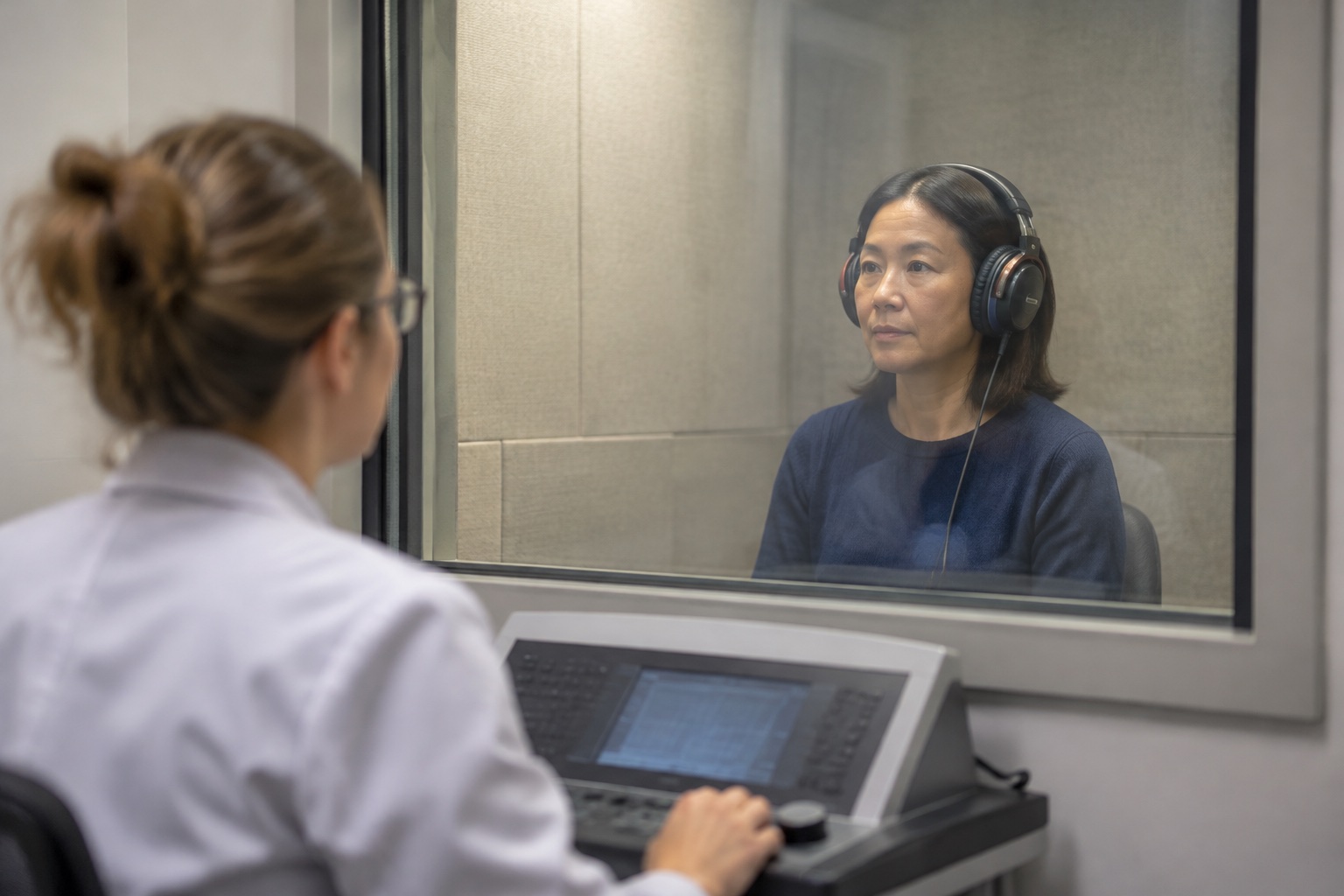
2. Surveillance: Word-Recognition Audiometry and 1 mm IAC MRI
Tumor diameter alone poorly predicts functional hearing in NF2-SWN; even small intracanalicular schwannomas can degrade speech comprehension through cochlear nerve ischemia or perilymphatic protein elevation. Multidisciplinary centers track two coupled metrics every 6 to 12 months:
- Word Recognition Score (WRS, 50-word monosyllabic lists): Tracks functional speech clarity alongside pure-tone average (PTA in dB HL). Treatment responses and surgical hearing-sparing candidacy rely on WRS thresholds (using the 95% critical difference table).
- High-Resolution Cranial MRI with 1–1.5 mm Thin Cuts Through the Internal Auditory Canal (IAC): Combined with baseline whole-spine MRI and pediatric slit-lamp screening for posterior subcapsular or cortical wedge cataracts (often the earliest childhood sign of NF2-SWN before tinnitus appears).
3. Systemic Bevacizumab, Microsurgery, and Auditory Implants
Unlike sporadic unilateral vestibular schwannomas, aggressive surgery or stereotactic radiosurgery in NF2-SWN carries heightened risks of bilateral deafness, facial nerve (CN VII) palsy, or secondary radiation malignancy. Modern management prioritizes functional hearing years:
| Modality | Primary Clinical Scenario | Expected Outcome & Key Precautions |
|---|---|---|
| IV Bevacizumab (Anti-VEGF) | Progressive vestibular schwannoma with declining WRS or brainstem compression | 35%–45% objective hearing improvement and ≥20% radiographic shrinkage; induction 5–7.5 mg/kg q2–3w, then maintenance 2.5–5 mg/kg q3–4w. Monitor blood pressure and urine protein/creatinine ratio. |
| Hearing-Sparing Decompression / Resection | Selected small tumors (middle-fossa approach) or brainstem-compressing mass | Requires high-volume skull-base team with continuous CN VII & cochlear nerve action potential monitoring. |
| Cochlear Implant (CI) vs Auditory Brainstem Implant (ABI) | Severe-to-profound bilateral hearing loss | Cochlear implantation yields superior open-set speech perception whenever the cochlear nerve remains anatomically intact (even with stable treated tumor); ABI is reserved when CN VIII is severed. |
Platform basket trials such as INTUITT-NF2 (ClinicalTrials.gov) continue evaluating oral kinase inhibitors including brigatinib (ALK/FAK blockade) and focal adhesion kinase inhibitors for NF2-associated meningiomas and schwannomas refractory to bevacizumab.
Frequently Asked Clinical Questions
What is the earliest sign of NF2-related schwannomatosis in children?
Whereas adults typically present with unilateral tinnitus, muffled speech comprehension, or balance unsteadiness in their teens or twenties, children with NF2-SWN often present earlier with posterior subcapsular cataracts, subtle mononeuropathy (facial weakness or foot drop), or raised skin-plaque schwannomas.
Can patients with NF2-SWN receive a cochlear implant instead of a brainstem implant?
Yes. Whenever the cochlear nerve fibers remain anatomically continuous—such as after bevacizumab stabilization or nerve-sparing decompression—a cochlear implant generally achieves markedly clearer speech understanding than an auditory brainstem implant.
Key Consensus Guidelines & Primary Sources
- Legius E, Messiaen L, Wolkenstein P, et al. Revised diagnostic criteria for neurofibromatosis type 1 and Legius syndrome: an international consensus recommendation. Genetics in Medicine. 2021;23(8):1506–1513. PubMed 34012067.
- Plotkin SR, Messiaen L, Legius E, et al. Updated diagnostic criteria and nomenclature for neurofibromatosis type 2 and schwannomatosis: an international consensus recommendation. Genetics in Medicine. 2022;24(9):1967–1977. PubMed 35674741.
- Gross AM, Wolters PL, Dombi E, et al. Selumetinib in children with inoperable plexiform neurofibromas (SPRINT Phase II). New England Journal of Medicine. 2020;382(15):1430–1442. PubMed 32187457.
- Moertel CL, Hirbe AC, Shuhaiber HH, et al. ReNeu: A pivotal phase IIb trial of mirdametinib in adults and children with symptomatic neurofibromatosis type 1-associated plexiform neurofibroma. Journal of Clinical Oncology. 2025;43(7):758–769. PubMed 39514828.
- Miller DT, Freedenberg D, Schorry E, et al. Health supervision for children with neurofibromatosis type 1 (American Academy of Pediatrics). Pediatrics. 2019;143(5):e20190660. PubMed 30988031.