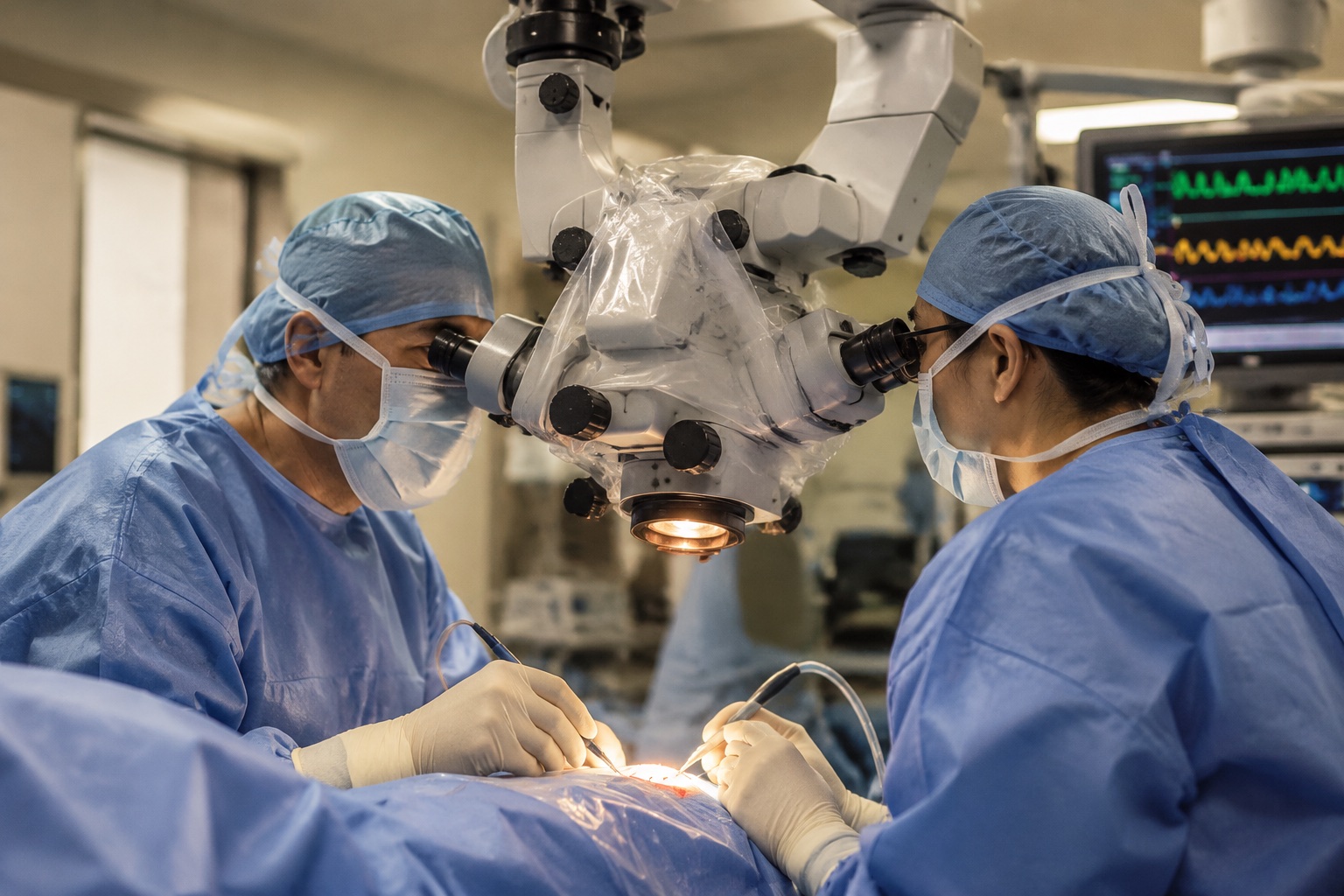
1. Recognizing MPNST and Premalignant ANNUBP Lesions Early
Four clinical "red flags" require urgent referral to an NF sarcoma/neurosurgery center: (1) constant pain lasting >2–4 weeks or waking the patient from sleep, (2) rapid enlargement of a focal nodule ("distinct nodular lesion") inside an older plexiform tumor, (3) transition from soft/compressible to stone-hard consistency, or (4) new motor weakness or radicular numbness.
| Lesion Category | 18F-FDG PET/CT SUVmax & MRI ADC | Recommended Surgical Strategy |
|---|---|---|
| Benign Plexiform Neurofibroma | SUVmax typically < 2.5–3.0; classic "target sign" preserved on T2 MRI | Avoid morbid radical surgery; treat symptomatic cases with oral MEK1/2 inhibitor or targeted functional debulking. |
| ANNUBP (Atypical Neurofibromatous Neoplasm of Uncertain Biologic Potential) | Intermediate FDG avidity (SUVmax ~3.0–5.5), loss of T2 target sign, CDKN2A/p16 deletion | Marginal / fascicle-sparing complete excision cures >95% of ANNUBPs without mutilating wide sarcoma margins or radiation! |
| High-Grade MPNST | SUVmax typically ≥ 3.5–4.0 (often >6.0) with restricted diffusion (ADC < 1.0 × 10⁻³ mm2/s) | PET-guided core biopsy of hottest focus followed by en-bloc R0 negative-margin sarcoma resection (± neoadjuvant anthracycline/ifosfamide chemotherapy). |
2. Critical Safety Rule: Avoiding Unnecessary Ionizing Radiation
Because every somatic cell in an NF1 or NF2-SWN patient already carries one inactivated tumor-suppressor allele ("first hit"), therapeutic radiotherapy—and repeated diagnostic CT scans—dramatically accelerates loss of the remaining wild-type allele, multiplying rates of radiation-induced MPNST, high-grade glioma, and moyamoya cerebral vasculopathy. MRI (without radiation) is always preferred over CT for routine surveillance, and radiotherapy is avoided for benign optic pathway gliomas or plexiform tumors.
3. Cutaneous Neurofibroma Removal & Orthopedic Spine/Tibia Care
- Cutaneous Neurofibromas (cNFs): Benign dermal bumps appearing during puberty, pregnancy, and adulthood never turn malignant, yet pruritus, friction on clothing, and visible burden strongly affect quality of life. Effective office procedures include electrodessication (rapid treatment of dozens to hundreds of small sessile lesions under local/tumescent anesthesia), CO2 or Er:YAG laser ablation, and cold-steel elliptical excision for pedunculated lesions. Topical MEK-inhibitor gels remain in clinical trials.
- Dystrophic Scoliosis & Tibial Pseudarthrosis: NF1 scoliosis divides into non-dystrophic curves (treated like idiopathic scoliosis) and dystrophic curves (short-segment sharp angulation across 4–6 vertebrae with rib penciling and dural ectasia), which always require pre-operative whole-spine MRI to identify paraspinal plexiform invasion prior to combined fusion. Infantile anterolateral tibial bowing requires immediate protective bracing (total-contact ankle-foot orthosis) before fracture occurs.
Frequently Asked Clinical Questions
Can small skin-surface cutaneous neurofibromas turn into malignant cancer?
No. Superficial dermal/cutaneous neurofibromas do not transform into malignant peripheral nerve sheath tumors (MPNST). Malignant transformation arises from deep internal or plexiform neurofibromas.
Why is radiotherapy avoided for NF1 optic gliomas whenever possible?
Therapeutic cranial radiation in NF1 carries high risks of secondary malignant brain/nerve tumors, neurocognitive decline, and moyamoya cerebral artery stenosis. Carboplatin/vincristine chemotherapy or MEK inhibition is used instead.
Key Consensus Guidelines & Primary Sources
- Legius E, Messiaen L, Wolkenstein P, et al. Revised diagnostic criteria for neurofibromatosis type 1 and Legius syndrome: an international consensus recommendation. Genetics in Medicine. 2021;23(8):1506–1513. PubMed 34012067.
- Plotkin SR, Messiaen L, Legius E, et al. Updated diagnostic criteria and nomenclature for neurofibromatosis type 2 and schwannomatosis: an international consensus recommendation. Genetics in Medicine. 2022;24(9):1967–1977. PubMed 35674741.
- Gross AM, Wolters PL, Dombi E, et al. Selumetinib in children with inoperable plexiform neurofibromas (SPRINT Phase II). New England Journal of Medicine. 2020;382(15):1430–1442. PubMed 32187457.
- Moertel CL, Hirbe AC, Shuhaiber HH, et al. ReNeu: A pivotal phase IIb trial of mirdametinib in adults and children with symptomatic neurofibromatosis type 1-associated plexiform neurofibroma. Journal of Clinical Oncology. 2025;43(7):758–769. PubMed 39514828.
- Miller DT, Freedenberg D, Schorry E, et al. Health supervision for children with neurofibromatosis type 1 (American Academy of Pediatrics). Pediatrics. 2019;143(5):e20190660. PubMed 30988031.